
Manual Therapy in Spokane Valley
Ask most people what physical therapy looks like and they'll describe a sheet of exercises and a band looped around a doorknob. Manual therapy is the part that comes first — the clinician's hands finding the joint that won't glide or the tissue that won't release, and treating it directly. When something is mechanically stuck, hands-on work reaches what exercise alone can't.
How manual therapy actually works
Manual therapy treats the movement problems the body can’t resolve on its own. A joint that has lost part of its normal glide, a muscle locked in a protective contraction, a band of connective tissue that has thickened and stopped sliding — each one limits how you move, and the body compensates around it. The compensation is usually where the pain shows up, often at a distance from the actual restriction.
The clinician’s hands do two jobs at once. First as the assessment tool: by moving a joint or loading a tissue and feeling exactly where and how it stops, the clinician locates the restriction more precisely than any general exercise can. Then as the treatment: graded, specific force restores the motion that was lost.
The effect works on two levels. Mechanically, mobilization restores the small accessory movements inside a joint, and soft tissue work lengthens what had shortened and frees what had adhered. Neurologically, the same input signals the nervous system to release its protective guarding — the reflexive muscle tension that builds around an injury and outlives it. That second effect is why pain and tightness often ease within the session, before any lasting tissue change has had time to happen.
Why hands-on reaches what exercise can't
A joint doesn’t simply hinge open and shut. As it moves, the surfaces roll and glide against each other — small accessory motions you can’t perform on purpose. When that glide is lost, usually after an injury, a surgery, or a long stretch of not moving, the joint stops short of its full range and no amount of stretching restores it. Stretching pulls on a door that’s locked at the hinge.
A stiff shoulder after surgery or a long period in a sling is the clearest example. The patient can’t raise the arm, but often the muscle isn’t the limit — the joint capsule has tightened and lost its glide. Hand that patient a set of exercises and they push against the restriction without changing it. Restore the glide by hand first, and the range opens; then exercise has something to build on. Manual therapy almost always works in that order — open the motion, then load it.
Patient Support
(509) 413-1630
info@synergyspokane.com
Commonly Used Therapies:
What a Session Looks Like
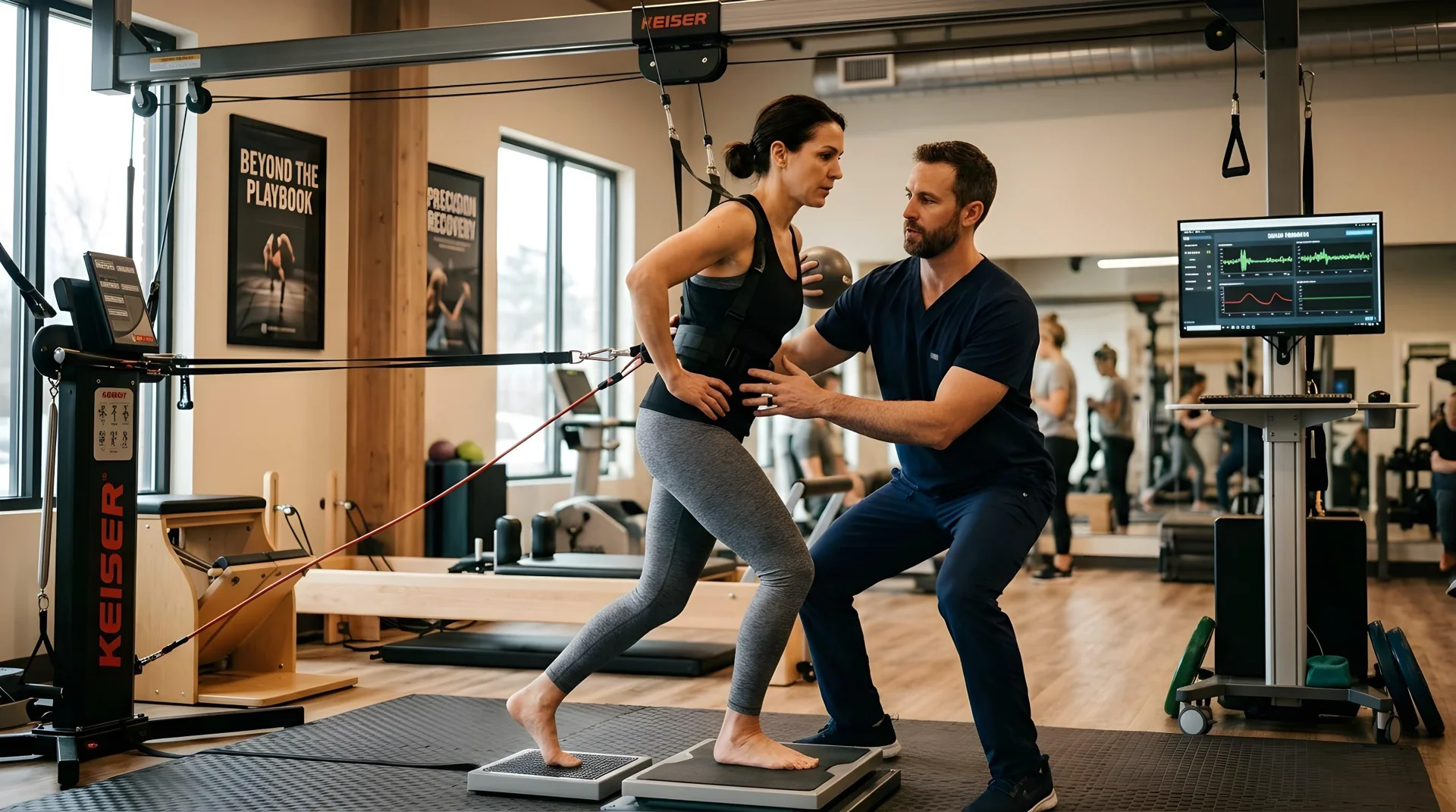
Treatment starts with movement, not paperwork. The clinician takes the joint or tissue through its range and feels for where it stops and what the stop feels like — a hard mechanical block, a springy capsule, and a guarded muscle each point to different work. They compare the restricted side against the other to gauge how much range is missing.
From there the work matches the finding. Joint mobilization uses slow, graded pressure to restore glide. Soft tissue mobilization and myofascial release address muscle and connective tissue that has tightened or bound down. Manual stretching takes a shortened muscle through length the patient can’t reach alone. None of it is the fast, high-velocity thrust associated with chiropractic adjustment — manual therapy here is graded and sustained, applied at the edge of your available range and advanced as that range opens.
The hands-on work is usually paired with active movement. Once a joint or muscle opens up, the clinician has you move into the new range immediately, so the gain holds instead of fading by the next visit.
Sessions are hands-on throughout and typically run 30 to 45 minutes. Most patients feel more range and less tightness the same day. Lasting change — the kind that holds without retreatment — usually builds over several sessions as the new motion gets reinforced with active work.
What manual therapy is often used for
Most patients who come to Synergy for manual therapy fall into one of these groups:
After a total joint replacement — hip, knee, or shoulder — or any procedure that requires a period of immobilization, manual therapy restores the range the joint lost while it was protected, before that stiffness has a chance to set in permanently.
When the joint capsule itself tightens, range disappears in a predictable pattern. Restoring it is mechanical work that responds well to graded mobilization.
Pain that worsens in specific directions — turning the head, bending, twisting — often traces to a segment that has stopped moving normally. Manual therapy addresses the restriction rather than only the symptom.
After an auto or work injury, guarding and restricted movement frequently outlast the original tissue injury. Hands-on work releases the guarding and rebuilds the motion.
Any joint that no longer moves through its full, expected range — from injury, surgery, or simple disuse — is a direct target for manual therapy.
Manual therapy bridges the gap. It reduces pain and restores enough motion that strengthening and return-to-activity work can actually begin.
Related Reading
Total Body Balancing evaluates the whole body to find the source of dysfunction rather than the site of pain, merging manual techniques into one treatment.
A muscle strain is fibers or tendons torn past their capacity, graded mild to severe by how many tore.
MMA produces more injuries than almost any sport. The injuries the sport creates and how physical therapy fits into recovery.
Two major causes of lower back pain: overuse injury and degenerative change in the spine.
Americans spend $50 billion a year on low back pain, the leading cause of job-related disability.
A Synergy therapist explains why an evaluation for shoulder pain starts with how the whole body moves, and what site-of-pain treatment misses.
Twenty-four bones, the plantar fascia and the Achilles tendon: how foot pain starts, from athlete's foot to a torn tendon, and what keeps you on your feet.
Every patient deserves a Spokane Valley physical therapy service that meets their needs.