The scenario below is illustrative — a composite built from patterns we see across L&I shoulder claims, not an actual patient or claim file, so no identifying details are present.
The file said the case was ready to close.
Fourteen weeks, a right rotator cuff strain, and every number back where it should be. Grip strength within five percent of the uninjured side. Lifting cleared to forty pounds. The kind of L&I physical therapy case that gets a quick signature and a return-to-work date without much conversation.
Then, at the final evaluation, the worker reached across his body toward a conveyor — a motion his shift required hundreds of times a day — and the arm stalled halfway up.
Here’s the task that almost didn’t get tested and what caught it.
The Claim That Should Have Closed on Schedule
Picture an order picker in his mid-forties, right-hand dominant, hurt reaching for an overhead tote in month one of the claim. Standard trajectory after that — anti-inflammatories, a home exercise program, weeks of strengthening. By the time a case like this lands with us, most of the obvious deficits are gone.
On paper, it’s finished. Range of motion is symmetrical. Strength testing green across the board. Grade the shoulder as an isolated joint, and there’s nothing left to treat.
That’s the trap. L&I physical therapy doesn’t clear a joint. It clears a person to do a specific job — and the job is still sitting there, untested.
Why the Job Analysis Is the Document That Actually Decides
Every L&I claim has a Job Analysis behind it. It lists the physical demands of the actual position — how much weight, how often, at what height, in what posture. Not a general fitness standard. The specific job.
In a case like this, one line on the JA matters more than the rest: a requirement for frequently reaching above shoulder height and across the body to load a moving conveyor. In L&I terms, “frequent” means one-third to two-thirds of a shift.
Grip and lifting numbers don’t touch that line. You can pass every isolated strength test and still be unable to meet the one demand that defines the role.
The JA decides the case. Everything else is supporting evidence.
The Reaching Task Nobody Tested Until the End
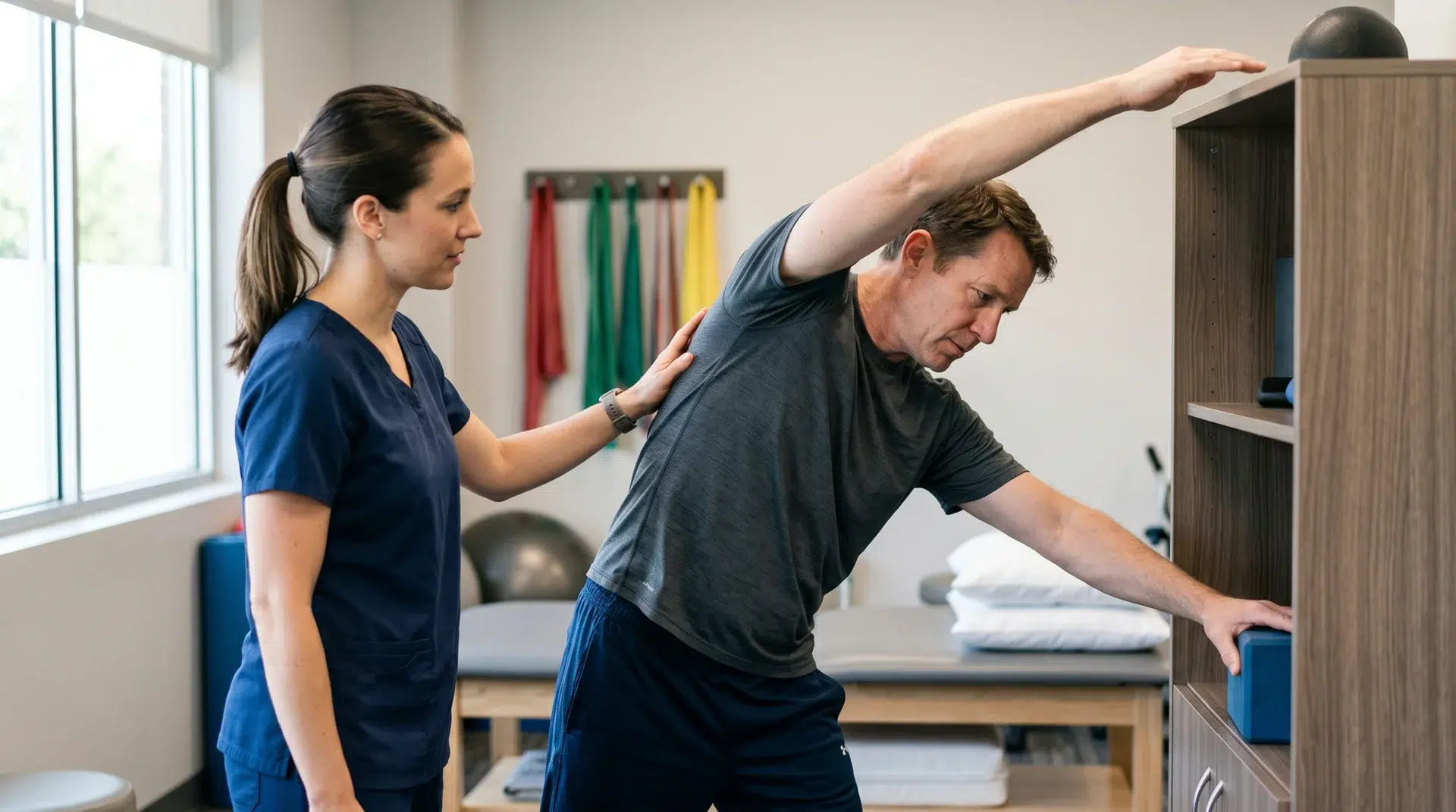
So it gets replicated. A twelve-pound tote, a shelf set at conveyor height, the same cross-body-and-up path the job requires.
The arm reaches roughly 70 degrees and stops. Not from pain — it just won’t track the rest of the way without the trunk twisting to cheat the motion. Do that once, fine. Do it four hundred times a shift, and there’s a reinjury waiting on a calendar.
That’s what makes this pattern worth flagging. Every isolated test can pass for weeks. The compound movement — the one the job is actually built on — never gets loaded at that exact angle until the final evaluation. And it fails the first time it’s asked.
The Gap Wasn’t in the Shoulder
The shoulder is fine. That’s the part conventional protocols keep missing.
The restriction lives up the chain — limited thoracic rotation, a scapula that won’t upwardly rotate past a certain point, a myofascial tether through the lat and serratus that only loads at that reaching angle. Below seventy degrees, everything moves cleanly. Past it, the tissue runs out of glide, and the whole arm stalls.
Strength tests alone never reach that position.
These tests measure the joint at neutral, in a plane, against resistance.
Real reaching is rotation, elevation, and load, all at once.
If you miss the interaction, you clear a body that can’t do its job properly.
What Integrated Manual Therapy Catches That an Exercise Protocol Misses
This pattern shows up often — the deficit isn’t where the injury was. An exercise-only program keeps drilling the shoulder because that’s what the claim names.
The reach never improves because the reach was never the problem.
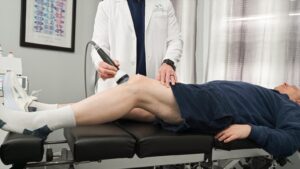
Integrated manual therapy offers a more holistic approach. A hands-on assessment finds exactly where the movement stalls between mid-back and fingertip.
In this circumstance, Synergy often utilizes Myofascial release through the latissimus and serratus, followed by strain counterstrain to quiet the guarding, then retraining the scapular rhythm under a real load that the job demands.
It’s important to distinguish between treating the diagnosis on the claim and treating the movement the job demands.
One gets a signature. The other gets a return-to-work date that sticks.
The Cost of a False Clearance
Consider a case where nobody tests the reach.
The worker gets approved for return to work, returns to the conveyor line job, and, around week two, the trunk-twisting compensation torques something that wasn’t previously injured. The claim opens right back up.
What was a straightforward shoulder strain may become a chronic case with a second injury layered on the first. The cost isn’t just a few more PT visits — it’s months, a worse outcome, and a worker who now trusts the process a little less every round.
A clearance that’s wrong is more expensive than one that takes three extra weeks.
What a Clean Return-to-Work Clearance Actually Requires
In this scenario, the real clearance comes three weeks later. Full reach, full load, no cheat in the trunk.
An L&I return-to-work clearance must match a worker’s capacity to the movements in the Job Analysis, at the specific angles and loads the shift actually demands. Isolated numbers are a starting point. They shouldn’t be the finish line.
If an L&I physical therapy case has stalled at “plateaued,” or a clearance is coming, and the job involves reaching, rotation, or anything overhead, that’s worth a second look before the signature — not after the reinjury.
Have a stalled L&I case, or a return-to-work clearance that involves overhead or cross-body work? A single functional evaluation against the Job Analysis usually reveals the real gap — before it becomes a reopened claim.
Contact Synergy Healthcare today and our friendly staff will get in touch as soon as possible.
Want to learn more about the Return to Work Clearance process? Visit the L&I website for more details.