
“Sciatica” tells a clinician where it hurts and nothing about why. The same shooting pain down the back of the leg can come from a lumbar disc pressing on a nerve root, a deep gluteal muscle clamping the nerve in the hip, or a nerve that has become mechanically irritable along its whole track with no single structure to blame. Those three problems need different treatment, and the most popular home stretch for sciatica makes two of them worse. The evaluation that sorts them out is the whole job. Get it wrong, and you spend six weeks treating a leg that was never the source.
One Word on the Intake Form Covers Three Different Problems
Most patients arrive already diagnosed. A doctor, a chiropractor, or a search bar told them they have sciatica, and they’ve been managing it as one condition for months.
The word is accurate, just as “headache” is. It doesn’t tell anyone what to do.
We see some version of this fairly often at Synergy. A patient finishes a round of standard PT somewhere else, does the stretches, gets discharged as plateaued, and is still easing into the driver’s seat sideways. Usually the leg was treated hard, and the origin was never named. A clinic running one sciatica protocol gets decent results for the patients whose origin happens to match the protocol. The rest are told to wait.
How Disc, Piriformis, and Nerve Tension Each Give Themselves Away
The three origins leave different fingerprints before anyone touches the patient.
Disc-related sciatica is a nerve root problem at the spine, usually L4 through S1. It’s worse after sitting, worse when bending forward, often the worst first thing in the morning, and a cough or sneeze can send it down the leg. Back pain usually comes with it, and the leg symptoms move farther down when it’s flaring and back toward the spine when it’s settling.
With piriformis or deep gluteal syndrome, the nerve gets caught in the buttock, well below the spine. The pain sits in the hip and is usually worse when the patient is sitting right on it — car seats and a wallet in the back pocket are the usual culprits — while the low back often feels fine. Rotating the hip will generally bring the symptoms back.
The third one, nerve mechanosensitivity, is the one that confuses people. The nerve has turned irritable along its whole length, and in some cases the disc or hip problem that set it off has already cleared up. Now anything that puts the nerve under tension provokes it: sitting with the legs out straight, slumping, or pulling the toes up at the end of a hamstring stretch. Imaging on these patients usually comes back clean, which is how they end up being told nothing is wrong.
Why the Figure-Four Stretch Makes Two of the Three Worse
Search “sciatica stretches,” and the first result is some version of the figure-four: lie on your back, cross one ankle over the opposite knee, pull the knee toward your chest. It’s a good piriformis stretch. That’s the only origin it helps.
For many disc patients, pulling the knee to the chest flexes the lumbar spine and loads the back of the disc, often the same direction that pushed it onto the nerve root in the first place. Not always, though. Depending on which direction the disc is pressing on the nerve, flexion can help, which is exactly why direction gets tested before anyone hands out a stretch. For a mechanosensitive nerve, the stretch runs tension straight through already irritated tissue, and irritated nerves respond to tension by getting more irritated. Neither patient feels worse during the stretch. They feel worse that night or the next morning, blame the mattress, and stretch again.
So the patient who has done “the sciatica stretch” faithfully for two months and gotten worse hasn’t failed at compliance. They’ve been running the right treatment on the wrong diagnosis, which is a slower way of doing nothing.
How the First Visit Separates Back, Hip, and Nerve
Before anything gets touched, there is a conversation, and it generally settles about half of the question on its own. A disc, a hip, and an irritable nerve all give different answers when the patient is asked which positions aggravate the leg, whether there’s an hour of the day that is reliably the worst, and whether the pain travels down the leg or stays put where it started. Setting aside an hour for one person leaves enough room to ask all three and then chase down whatever the answers open up.
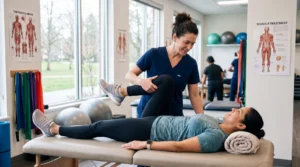
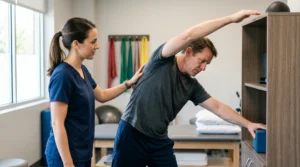
After the history comes the exam, which either supports what the patient described or argues against it. A suspected disc gets repeated movement testing — ten or fifteen bends backward, then the same forward. If the leg pain retreats toward the spine, the disc is driving it, and whichever direction brought the relief becomes the treatment.
Whether the nerve is under tension is a separate question with its own two tests: a straight leg raise with the ankle pulled up, and the slump test. The ankle doesn’t move the disc, and it doesn’t move the hip, so when pulling the toes up changes what the leg is doing, the nerve itself is involved, whatever sets it off. For the hip itself, we load it into flexion, adduction, and internal rotation and palpate the deep gluteal space to see whether the piriformis reproduces the symptoms.
The part most orthopedic evals skip is the abdomen and pelvis. The nerve roots that form the sciatic nerve pass through and beside the psoas, and the nerve exits the pelvis next to the pelvic floor. An old appendectomy scar, a hysterectomy, chronic constipation, or a psoas that never let go after a pregnancy can hold upstream tension on those structures for years. Nothing in the back or the hip will explain that patient, and no amount of back or hip treatment will fix them.
Clinics tend to evaluate for what they can treat, so when exercise and a hot pack are the whole menu, the evaluation rarely travels past the spine.
Matching the Technique to the Source
With the origin named, the choice of technique comes from the problem rather than whatever happens to be available down the hall.
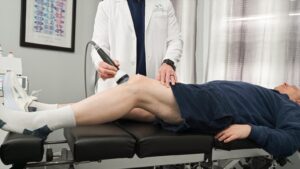
Strain counterstrain is the usual answer when the trouble is in the buttock: the muscle is positioned into shortening and held there, so the spasm lets go on its own instead of being stretched against. An irritable nerve calls for neural manipulation, which aims to restore the nerve’s ability to slide within the tissue it runs through, and it comes with a firm instruction to stop stretching it. When the restriction sits upstream, in the abdomen or the pelvis, gentle manual work on the tissue releases whatever is pulling on the nerve from above. Discs are the odd one out here, since they generally need less hands-on work than the rest — directional loading that unloads the disc in a specific direction, and time. Counterstrain and Myokinesthetics can also help across all three sources, which is why a treatment plan usually blends techniques instead of running just one.
Any given clinic in Spokane likely has one or two of those tools. Synergy uses all of them at 12012 E Mission in Spokane Valley, which is part of why people drive over from Liberty Lake and Coeur d’Alene once a case has stalled closer to home.
Stop the Stretch and Start Tracking
Try a useful experiment in the week before your appointment: drop the figure-four entirely and watch how the leg behaves without it. A leg that quiets down over those seven days has already given you a piece of information about where the trouble is coming from, and it didn’t take an examination to get there.
Keep a note of the positions and times of day that flare it up and the ones that quiet it down, and bring that with you. Washington is a direct access state, so no referral is needed for a PT evaluation, and the techniques above bill under standard PT codes. A properly done evaluation should tell a clinician in a single visit whether the problem is in the back, the hip, or the nerve, and the leg is generally the last thing to treat.
If you’ve been doing the sciatica stretch for more than a few weeks and the leg is no better, that’s the signal to get the origin named. Book an evaluation with Synergy in Spokane and bring your position notes to the first visit.
Clinically reviewed by Brad Lyons, MSPT, COMT on October 14, 2026.